

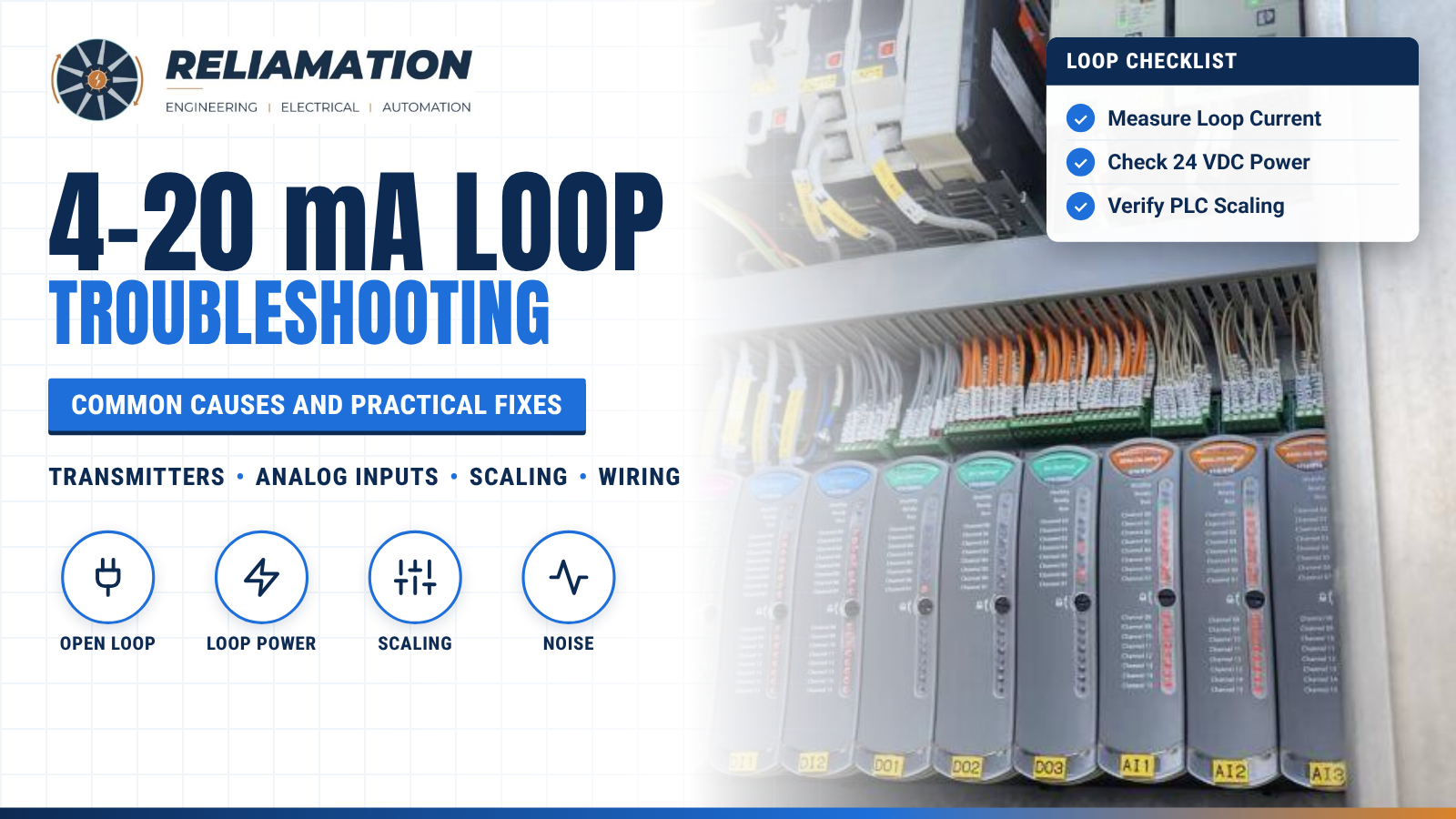
The 4-20 mA loop is still the most common way to send process signals in US plants. Pressure, level, flow and temperature transmitters all depend on it.
When a loop fails, the PLC and HMI show a wrong value, a frozen value or a bad-quality alarm. Operators lose trust in the reading, and control loops can act on bad data.
This guide covers the most common causes of 4-20 mA loop problems and practical ways to fix them.
How a 4-20 mA Loop Works
A 4-20 mA loop sends a current that represents the process value. 4 mA is the bottom of the range and 20 mA is the top. Because the signal starts at 4 mA, a reading of 0 mA tells you the loop is broken, not that the value is zero.
Most loops use a 24 VDC power supply. In a 2-wire loop, the transmitter is powered by the loop itself. In a 4-wire loop, the transmitter has its own separate power.
Common Symptoms
- Reading stuck at 0 mA or below 4 mA
- Reading stuck high, at or above 20 mA
- Value that jumps around or drifts
- Value that is steady but wrong
- Bad-quality or out-of-range alarm on the HMI
Common Causes and Practical Fixes
Open circuit. A broken wire, loose terminal or blown fuse gives 0 mA. Check terminations from the field device to the I/O card and check the loop fuse.
No loop power. Check the 24 VDC supply at the panel and at the transmitter terminals. Make sure the voltage at the transmitter meets its minimum rating.
Wrong wiring for the card type. A 2-wire transmitter on a card set up for 4-wire signals, or the reverse, will not work. Check the I/O card wiring diagram and its configuration.
Transmitter fault or failure signal. Many transmitters drive the signal below 3.6 mA or above 21 mA to report a fault, following NAMUR NE 43. Check the transmitter display or diagnostics before replacing anything.
Scaling mismatch. If the transmitter range and the PLC scaling do not match, the value will be steady but wrong. Compare the transmitter’s range with the PLC and HMI scaling.
Electrical noise and ground loops. Noisy or jumping values often come from poor shielding or grounding. Ground the cable shield at one end only, usually at the panel, and keep signal cables away from VFD and power cables.
Too much loop resistance. Long cable runs, extra meters or barriers can drop too much voltage. Add up the loop load and compare it with the power supply’s capacity.
A Simple Step-by-Step Check
- Check the HMI and PLC. Note the raw value and any alarm.
- Measure the current. Use a loop-powered clamp meter or put a meter in series to read the actual mA.
- Compare the numbers. If the measured mA is correct but the PLC value is wrong, the problem is scaling or the I/O card.
- Check power and wiring. Measure loop voltage and inspect terminations.
- Test the transmitter. Check its diagnostics, or use a loop calibrator to simulate a signal.
- Document the fix. Record what you found and update drawings if wiring changed.
Why Good Loop Maintenance Matters
Accurate analog signals are the base of good process control. Regular loop checks catch loose wiring, drifting transmitters and scaling errors before they cause bad control or false trips.
How Reliamation Can Help
Reliamation helps plants troubleshoot instrument loops, PLC analog inputs and HMI scaling issues. Our team supports loop checks, commissioning and ongoing maintenance for plants across Texas. See our 24/7 Controls Maintenance and Plant Start-up & Commissioning services.
Need Help Troubleshooting a 4-20 mA Loop?
Contact Reliamation to talk with our controls team.
Frequently Asked Questions
Get answers to common questions about industrial automation, PLC migration, HMI, SCADA, and control-system integration.
Reliamation provides industrial automation services including PLC programming, HMI and SCADA development, control system integration, legacy control-system migration, industrial networking, data reporting, system troubleshooting, and automation modernization.
Yes. Reliamation helps manufacturers migrate legacy platforms such as PLC-5 and SLC 500 to modern ControlLogix and CompactLogix systems while minimizing production disruption and preserving essential control functionality.
A PLC controls machines and industrial processes, an HMI allows operators to interact with equipment, and a SCADA system provides plant-wide monitoring, control, alarms, historical data, and reporting.
Yes. Reliamation develops custom HMI and SCADA solutions designed around each facility’s equipment, operating requirements, alarm strategy, security standards, and reporting needs.
In many cases, yes. A phased modernization approach can retain compatible equipment while replacing obsolete controllers, communication networks, operator interfaces, and other high-risk components.
Reliamation’s automation and control-system solutions can support manufacturing, food and beverage, plastics, packaging, material handling, water treatment, energy, and other process-driven industries.
Industrial automation can reduce downtime through reliable controls, real-time alarms, equipment diagnostics, historical data, preventive-maintenance insights, and faster troubleshooting.
You can contact Reliamation through the website to discuss your existing control system, operational challenges, modernization requirements, and project goals with an industrial automation specialist.