

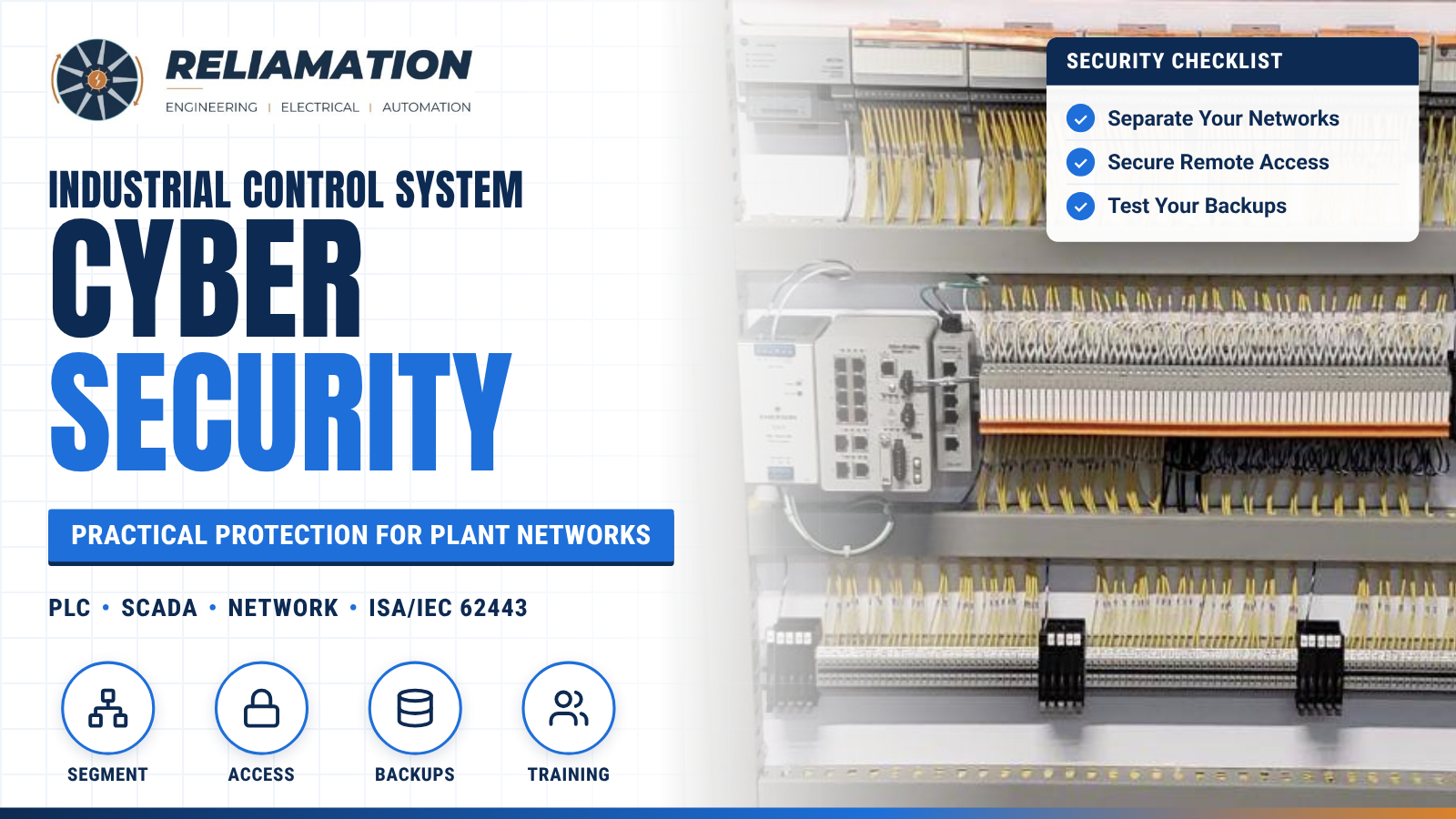
Plants are more connected than ever. PLCs, HMIs and SCADA servers now share data with business systems, cloud tools and remote users. That brings real benefits, but it also opens new doors for attackers.
A cyber incident on a control system is not just an IT problem. It can stop production, damage equipment or create safety risks.
The good news is that most risk can be reduced with a few practical steps. This guide covers the basics every plant team should have in place.
Why Control Systems Are at Risk
- Many PLCs and HMIs were designed before cybersecurity was a concern
- Control and business networks are often connected with little separation
- Remote access tools are sometimes left open for vendors
- Shared passwords and default logins are still common
- Old Windows computers cannot always be patched
Standards and Guidance to Know
ISA/IEC 62443 is a series of standards for securing industrial automation and control systems. It covers asset owners, system integrators and product suppliers across the full system lifecycle.
CISA (the US Cybersecurity and Infrastructure Security Agency) publishes free recommended practices for industrial control systems. Its Cross-Sector Cybersecurity Performance Goals also reference ISA/IEC 62443.
You do not need to adopt every part of these standards at once. Start with the basics below.
7 Practical Steps to Improve ICS Security
- Know what you have. Keep an up-to-date list of every PLC, HMI, server, switch and network connection.
- Separate your networks. Keep the control network apart from the business network. Use firewalls and controlled connection points between them.
- Secure remote access. Use one approved, secure remote access method. Turn off vendor access when it is not in use.
- Control user accounts. Remove shared and default logins. Give each person their own account with only the access they need.
- Back up regularly. Keep current, tested backups of PLC programs, HMI projects and SCADA servers, including one copy offline.
- Manage changes. Track who changes PLC logic and when. Unexpected changes should be noticed and checked.
- Train your people. Teach operators and technicians to spot phishing, use USB drives safely and report odd behavior.
Start With a Simple Assessment
A basic assessment shows where you stand today. It reviews your network layout, remote access, accounts, backups and patching. The result is a short, prioritized list of fixes, so you can tackle the biggest risks first.
Build Security Into Upgrades
The easiest time to improve security is during a project. When you upgrade a PLC, SCADA system or network, include segmentation, user roles and backup routines in the design. It costs far less than adding them later.
How Reliamation Can Help
Reliamation designs and supports control systems with security in mind. We help plants document their systems, separate networks, set up secure remote access and keep reliable backups. Learn more about our Control System Integration and 24/7 Controls Maintenance services.
Need Help Securing Your Control System?
Contact Reliamation to discuss a review.
Frequently Asked Questions
Get answers to common questions about industrial automation, PLC migration, HMI, SCADA, and control-system integration.
Reliamation provides industrial automation services including PLC programming, HMI and SCADA development, control system integration, legacy control-system migration, industrial networking, data reporting, system troubleshooting, and automation modernization.
Yes. Reliamation helps manufacturers migrate legacy platforms such as PLC-5 and SLC 500 to modern ControlLogix and CompactLogix systems while minimizing production disruption and preserving essential control functionality.
A PLC controls machines and industrial processes, an HMI allows operators to interact with equipment, and a SCADA system provides plant-wide monitoring, control, alarms, historical data, and reporting.
Yes. Reliamation develops custom HMI and SCADA solutions designed around each facility’s equipment, operating requirements, alarm strategy, security standards, and reporting needs.
In many cases, yes. A phased modernization approach can retain compatible equipment while replacing obsolete controllers, communication networks, operator interfaces, and other high-risk components.
Reliamation’s automation and control-system solutions can support manufacturing, food and beverage, plastics, packaging, material handling, water treatment, energy, and other process-driven industries.
Industrial automation can reduce downtime through reliable controls, real-time alarms, equipment diagnostics, historical data, preventive-maintenance insights, and faster troubleshooting.
You can contact Reliamation through the website to discuss your existing control system, operational challenges, modernization requirements, and project goals with an industrial automation specialist.