

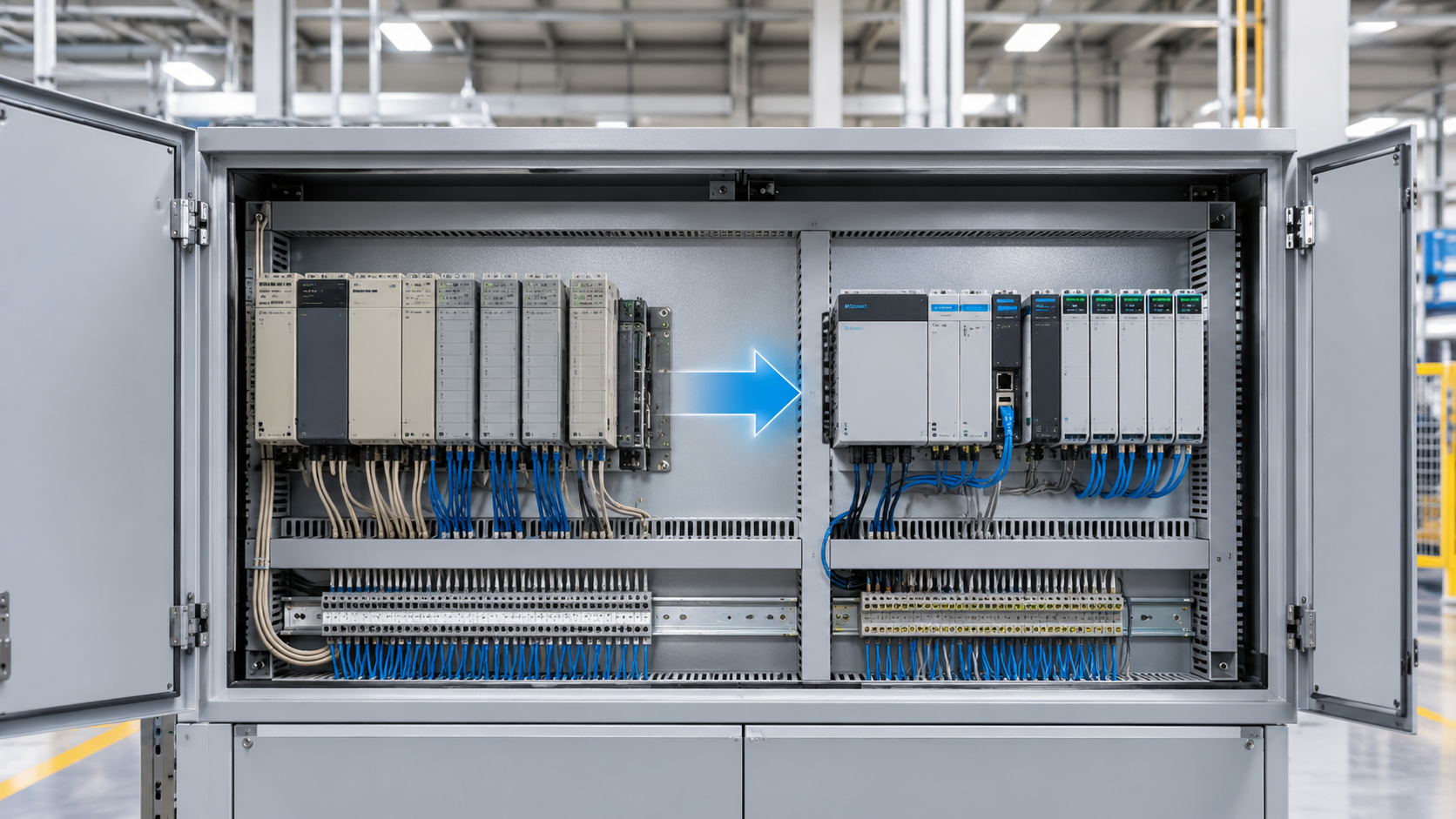
Many plants in Texas and across the US still run on Allen-Bradley PLC-5 and SLC 500 controllers. They have worked for decades. But reliable today does not mean supportable tomorrow.
Rockwell Automation discontinued the PLC-5 platform in 2017, and many SLC 500 processors are now discontinued too. Spare parts are getting harder to find and more expensive. Fewer technicians know the older networks. A single failed processor can stop a line for days.
This guide explains when to migrate, the common migration paths, and how to plan a cutover with minimal downtime.
Why Legacy PLCs Become a Risk
An old PLC is not a problem until something fails. The risk builds quietly:
- Spare parts: Replacement processors and I/O cards are often refurbished, with limited warranty.
- Skills gap: Fewer engineers know RSLogix 5, RSLogix 500, DH+ and Remote I/O.
- Old programming laptops: Some sites still keep an old laptop just to connect to the PLC.
- Limited data: Legacy controllers make it hard to share data with SCADA, MES or reporting tools.
- Cybersecurity: Older platforms were not designed for today’s connected networks.
Signs It Is Time to Migrate
You should start planning if:
- You have had a processor or I/O failure in the last few years
- Spare parts take weeks to arrive or cost more each year
- Only one person on site can support the PLC program
- You are adding equipment and the controller has no spare capacity
- You need better production data or remote monitoring
Common Migration Paths
PLC-5 to ControlLogix. This is the most common path for PLC-5 systems. In many cases, the existing 1771 I/O wiring can be reused with conversion hardware. This reduces rewiring, panel work and downtime.
SLC 500 to CompactLogix. Rockwell recommends the CompactLogix 5380 platform for SLC 500 users. It is a good fit for smaller machines and skids.
Phased migration. You can replace the processor first and keep the existing I/O. Then upgrade the I/O, HMI and network in later phases. This spreads the cost and lowers risk.
Full replacement. For heavily modified or poorly documented systems, a clean new design is sometimes faster and safer.
Plan the Migration Step by Step
- Audit the system. List every processor, I/O card, network, HMI and connected device.
- Back up everything. Save the PLC programs, HMI files and network settings before any change.
- Review the logic. Converted code needs cleanup. Look for unused logic, hard-coded values and undocumented changes.
- Choose the path. Decide between phased migration or full replacement based on risk, budget and downtime windows.
- Test before cutover. Test the new program offline or on a test panel before it touches the process.
- Plan the cutover. Schedule it during a planned shutdown. Have a clear rollback plan.
- Update the documents. Update drawings, I/O lists and backups once the system is live.
How to Reduce Downtime
Most owners worry about downtime more than cost. A few steps keep it short:
- Reuse field wiring where possible
- Pre-wire and test new panels before the shutdown
- Convert and test the logic before arriving on site
- Check every I/O point during startup, not after
- Keep the old program and hardware on hand until the new system is proven
Common Mistakes to Avoid
- Converting code automatically and skipping a review
- Forgetting HMI tags, alarms and SCADA links that point to the old PLC
- Missing communication links to drives, scales or third-party devices
- Leaving operators out of testing and training
How Reliamation Can Help
Reliamation is a control system integrator in Sugar Land, Texas. We help plants plan and complete PLC-5 and SLC 500 migrations, from system audit and code conversion to testing, startup and support. Learn more about our PLC-5 & SLC 500 Migration services.
Need Help With a Legacy PLC Migration?
Contact Reliamation to discuss your migration plan.
Frequently Asked Questions
Get answers to common questions about industrial automation, PLC migration, HMI, SCADA, and control-system integration.
Reliamation provides industrial automation services including PLC programming, HMI and SCADA development, control system integration, legacy control-system migration, industrial networking, data reporting, system troubleshooting, and automation modernization.
Yes. Reliamation helps manufacturers migrate legacy platforms such as PLC-5 and SLC 500 to modern ControlLogix and CompactLogix systems while minimizing production disruption and preserving essential control functionality.
A PLC controls machines and industrial processes, an HMI allows operators to interact with equipment, and a SCADA system provides plant-wide monitoring, control, alarms, historical data, and reporting.
Yes. Reliamation develops custom HMI and SCADA solutions designed around each facility’s equipment, operating requirements, alarm strategy, security standards, and reporting needs.
In many cases, yes. A phased modernization approach can retain compatible equipment while replacing obsolete controllers, communication networks, operator interfaces, and other high-risk components.
Reliamation’s automation and control-system solutions can support manufacturing, food and beverage, plastics, packaging, material handling, water treatment, energy, and other process-driven industries.
Industrial automation can reduce downtime through reliable controls, real-time alarms, equipment diagnostics, historical data, preventive-maintenance insights, and faster troubleshooting.
You can contact Reliamation through the website to discuss your existing control system, operational challenges, modernization requirements, and project goals with an industrial automation specialist.