

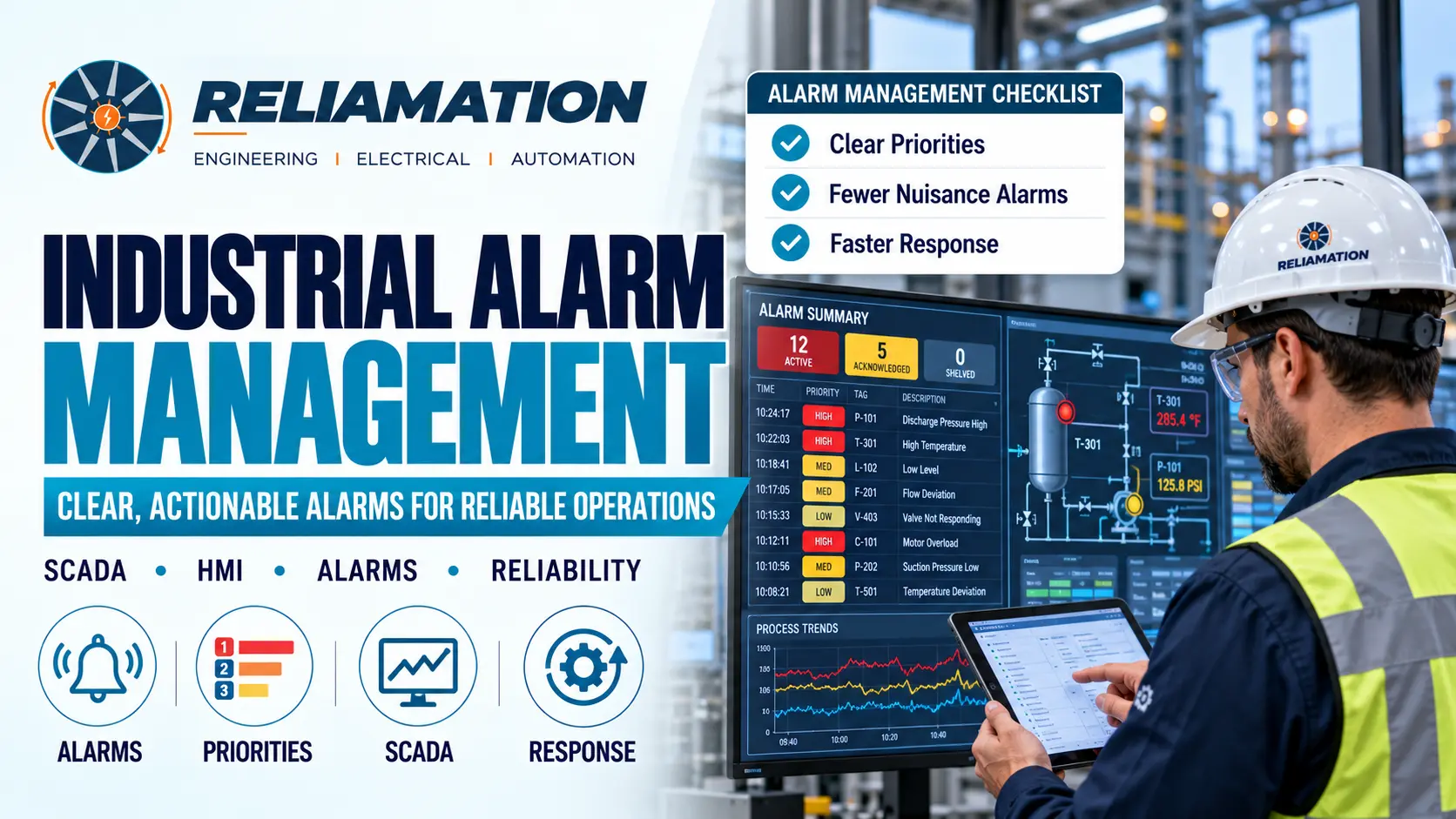
Modern industrial plants can generate thousands of process signals, equipment states, faults, warnings, and events every day.
However, not every abnormal condition should become an alarm.
When operators receive too many alarms, important information can become buried inside repeated warnings, low-value notifications, and alarms that appear without requiring any meaningful action. During a real process upset, that can make it harder to identify what happened first and what requires immediate attention.
For this reason, effective industrial alarm management is an important part of a well-designed PLC, HMI, and SCADA system.
A good alarm system does more than notify an operator that something changed. It provides clear information about an abnormal condition, indicates its importance, and helps the operator understand where attention is required.
ISA-18.2 provides a lifecycle framework for managing alarm systems in the process industries, including alarm philosophy, identification, rationalization, implementation, monitoring, maintenance, and management of change. isa.org
What Is Industrial Alarm Management?
Industrial alarm management is the structured process of designing, reviewing, prioritizing, maintaining, and improving alarms used in industrial control systems.
These alarms may appear through:
- HMI screens
- SCADA systems
- DCS platforms
- Annunciator systems
- PLC-based machine interfaces
The objective is not to create as many alarms as possible.
Instead, the objective is to create alarms that provide useful information when an operator needs to respond.
For example, a motor changing from stopped to running is normally an operating event. It may be useful to record, but it usually does not require an alarm.
A motor overload trip is different. Production may be affected, equipment may require inspection, and the operator may need to respond.
That distinction is the foundation of good alarm management.
Why Too Many Alarms Become a Plant Problem
Alarm problems often develop gradually.
A machine is commissioned with a set of alarms. Later, more alarms are added after equipment modifications. New engineers add additional warnings. Vendors install packaged systems with their own alarm lists. Eventually, the plant may have hundreds or thousands of configured alarms without a clear strategy for how they should behave.
The result can be alarm overload.
Operators may begin seeing the same alarms every shift. Some alarms appear briefly and disappear without action. Others repeatedly toggle between active and normal. Several different alarms may be generated by one equipment failure.
Over time, operators can become accustomed to ignoring low-value alarms.
The real danger appears when a serious process problem occurs and critical alarms arrive alongside dozens of less important notifications.
Good industrial alarm management reduces this noise so the most important conditions are easier to recognize.
Start With an Alarm Philosophy
Before modifying individual alarms, the facility should define how alarms will be managed.
An alarm philosophy acts as the operating standard for the alarm system.
It can define:
- What qualifies as an alarm
- Alarm priority levels
- Naming conventions
- Operator response expectations
- Alarm acknowledgement behavior
- Shelving or suppression rules
- Rationalization methods
- Performance monitoring
- Change-control requirements
The purpose is consistency.
Without an alarm philosophy, one engineer may classify a condition as critical while another treats a similar condition as a low-priority warning.
ISA-18 guidance treats the alarm philosophy as a foundational element of the alarm-management lifecycle. isa.org
Make Every Alarm Actionable
One of the most useful questions during alarm review is:
What should the operator do when this alarm appears?
If there is no meaningful operator response, the condition may not need to be an alarm.
For example:
Useful alarm:Cooling Water Pressure Low – Pump 2
The operator can investigate the cooling-water system, verify pump operation, and take corrective action.
Poor alarm:Pump 2 Status Changed
This may simply describe a system event without explaining whether something is wrong.
Events, status changes, maintenance messages, and alarms should not all be treated the same way.
A well-designed alarm system helps the operator understand abnormal conditions rather than simply reporting every change occurring inside the PLC.
Use Clear Alarm Messages
Alarm text should identify the equipment and the actual problem.
Avoid vague messages such as:
Alarm 104
System Fault
Machine Error
PLC Warning
These messages force the operator to search elsewhere for information.
A better message provides context immediately:
Conveyor 3 Motor Overload Tripped
Tank 2 High Level
PLC-02 Remote I/O Communication Lost
Cooling Water Pressure Low
Clear alarm messages reduce interpretation time during troubleshooting.
If equipment naming conventions are already used in electrical drawings, PLC tags, and HMI screens, the same naming convention should be used in alarm messages.
Set Alarm Priorities Carefully
Not every alarm has the same consequence.
A high-priority alarm should represent a condition that requires faster or more important operator attention than a lower-priority condition.
For example, an alarm associated with an immediate process or equipment risk should not appear with the same priority as a minor operating deviation.
Priorities should be based on defined criteria rather than personal preference.
Useful considerations may include:
- Safety impact
- Environmental impact
- Production impact
- Equipment damage
- Quality impact
- Time available for operator response
The important point is to avoid making everything high priority.
If every alarm is critical, the priority system no longer provides useful information.
Remove Nuisance Alarms
A nuisance alarm repeatedly activates without providing useful operator value.
Common examples include alarms that:
- Repeatedly toggle active and normal
- Appear during normal equipment startup
- Occur every shift without requiring action
- Duplicate another alarm
- Activate because of expected process transitions
- Remain active long after the operator can do anything about them
These alarms should be investigated rather than simply accepted as part of normal operation.
For example, a low-flow alarm that appears every time a pump starts may require an appropriate delay rather than immediate activation.
Similarly, if one network failure creates twenty secondary communication alarms, it may be better to identify and emphasize the primary failure.
Reducing nuisance alarms makes the remaining alarms more meaningful.
Use Alarm Delays Where They Make Operational Sense
Some process values briefly cross alarm thresholds during normal operation.
A small pressure fluctuation may last one second. A flow signal may momentarily drop during equipment startup. A sensor may fluctuate around its alarm limit.
If the alarm activates immediately every time this happens, operators may receive unnecessary notifications.
An appropriate alarm delay can prevent short, non-actionable conditions from creating alarms.
However, delays should be selected carefully.
A delay that is too long can hide a genuine process problem.
Therefore, the delay should reflect the process dynamics and the amount of time available for operator action.
Avoid Alarm Chattering
Alarm chattering occurs when an alarm repeatedly enters and leaves the active state because the process value remains close to its limit.
For example, a high-temperature alarm configured at 180°F may repeatedly activate and clear while temperature fluctuates between 179.9°F and 180.1°F.
This creates unnecessary alarm activity.
Deadbands can help prevent this behavior.
For example, the alarm might activate at 180°F but not clear until temperature falls below a lower reset point.
The exact value depends on the process.
The goal is to avoid repeated notifications caused by normal signal variation while still detecting the abnormal condition correctly.
Use Alarm Rationalization
Alarm rationalization is the structured review of configured alarms.
During rationalization, the team evaluates whether each alarm is necessary and how it should behave.
A review may consider:
- Alarm cause
- Potential consequence
- Operator response
- Priority
- Setpoint
- Delay
- Deadband
- Related alarms
The process should involve people who understand both the control system and plant operation.
Controls engineers understand PLC and SCADA behavior, while operators understand how process conditions develop during real production.
Combining both perspectives leads to better alarm decisions.
ISA’s alarm-management framework specifically includes alarm identification and rationalization as a formal lifecycle activity. isa.org
Distinguish Alarms From Events
Not everything important enough to record is important enough to alarm.
Events may include:
- Equipment started
- Equipment stopped
- Operator logged in
- Setpoint changed
- Recipe changed
- Automatic sequence completed
These events may be valuable for historical analysis and troubleshooting.
However, they normally do not require immediate operator intervention.
Keeping events separate from alarms prevents the alarm list from becoming a general activity log.
The alarm list should remain focused on conditions that require attention.
Design the HMI Around Abnormal Conditions
Alarm management and HMI design should work together.
An operator should be able to recognize an abnormal condition quickly and then navigate to the equipment or process area causing it.
Useful features can include:
- Alarm summary
- Priority indication
- Equipment identification
- Timestamp
- Acknowledgment status
- Direct navigation to affected equipment
- Related process values or trends
For example, clicking a high-level alarm for a tank could take the operator directly to the relevant process screen where level, inlet flow, outlet flow, and valve status are visible.
This reduces the time required to understand the situation.
Use Trends to Provide Context
An alarm tells the operator that a limit has been reached.
A trend can explain how the process reached that point.
For example, a high-temperature alarm tells the operator that temperature exceeded a threshold.
A trend may show whether temperature:
- Increased slowly over thirty minutes
- Rose suddenly
- Has been unstable all shift
- Began increasing after another process change
This additional context can improve troubleshooting.
For important process alarms, access to relevant historical trends can be extremely useful.
Review Alarm Floods After Process Upsets
During a major process upset, many alarms may occur within a short period.
This is commonly known as an alarm flood.
After the plant has returned to stable operation, the alarm sequence should be reviewed.
Questions to investigate include:
- Which alarm appeared first?
- Was the first alarm easy to identify?
- Which alarms were consequences of the original problem?
- Did unnecessary alarms distract the operator?
- Were priorities appropriate?
- Did operators receive enough information to respond correctly?
These reviews can reveal weaknesses that are difficult to identify during normal operation.
They also provide real plant data for improving the alarm system.
Monitor Alarm Performance Over Time
Alarm management is not a one-time engineering task.
A good alarm system can gradually deteriorate as equipment, PLC logic, HMI applications, and operating procedures change.
Therefore, alarm performance should be reviewed periodically.
Useful questions include:
- Which alarms occur most often?
- Which alarms remain active for long periods?
- Which alarms repeatedly chatter?
- Are some alarms always acknowledged without action?
- Are certain machines responsible for most alarm activity?
- Did recent modifications introduce new nuisance alarms?
ISA-18.2 treats monitoring, assessment, maintenance, and management of change as ongoing parts of the alarm-management lifecycle rather than a one-time design exercise. isa.org
A Practical Alarm Management Example
Consider a production line where operators receive repeated low-pressure alarms every time a pump starts.
The alarm is configured to activate immediately when pressure falls below the limit.
During startup, pressure naturally takes several seconds to stabilize. As a result, every normal startup produces an alarm.
Operators see this condition so often that they begin acknowledging it automatically.
The correct solution is not necessarily to remove the alarm.
Instead, the team reviews the process behavior and determines that pressure should recover within a defined period after the pump starts.
An appropriate delay is added.
Now the alarm activates only when low pressure continues longer than expected.
The alarm becomes meaningful again because it represents an actual abnormal condition rather than normal startup behavior.
This is the goal of effective industrial alarm management.
How Better Alarm Management Supports Plant Reliability
A well-managed alarm system can help operators identify abnormal conditions earlier and respond more effectively.
It can also support maintenance teams by providing clearer information about equipment failures.
For example, instead of seeing several generic machine faults, maintenance personnel may receive a specific alarm identifying loss of motor feedback or remote I/O communication.
Better alarm information can support:
- Faster troubleshooting
- Clearer operator response
- Improved process awareness
- Reduced nuisance notifications
- Better post-event analysis
- More consistent control-system behavior
The value comes from making alarms useful rather than simply increasing their number.
How Reliamation Can Help
Reliamation provides PLC programming, HMI and SCADA development, control-system integration, industrial networking, commissioning, troubleshooting, and automation modernization services.
Alarm performance is closely connected to PLC logic, HMI design, SCADA configuration, and plant operating requirements. Because of this, improving an alarm system often requires understanding the complete control architecture rather than changing alarm text alone.
A structured engineering review can help identify nuisance alarms, improve alarm priorities, clarify operator messages, and align alarm behavior with the actual process.
Need to Improve Your Industrial Alarm System?
Contact Reliamation to discuss PLC, HMI, SCADA, alarm-management, and control-system improvement requirements.
Frequently Asked Questions
What is industrial alarm management?
Industrial alarm management is the structured process of designing, prioritizing, reviewing, maintaining, and improving alarms used in PLC, HMI, SCADA, and other industrial control systems.
What is a nuisance alarm?
A nuisance alarm is an alarm that repeatedly appears without providing useful operator value. Common examples include alarms that chatter, occur during normal operation, or require no meaningful response.
What is alarm rationalization?
Alarm rationalization is the process of reviewing each alarm to determine whether it is necessary and to define its cause, consequence, operator response, priority, setpoint, and other important settings.
What is ISA-18.2?
ISA-18.2 is an ISA standard for managing alarm systems in the process industries. It defines a lifecycle framework covering areas such as alarm philosophy, rationalization, implementation, operation, maintenance, monitoring, and management of change. isa.org
Why should alarms have different priorities?
Priorities help operators distinguish conditions requiring immediate attention from lower-impact problems. If every alarm uses the highest priority, the priority system becomes ineffective.
What causes alarm chattering?
Alarm chattering commonly occurs when a process value repeatedly crosses an alarm threshold because of normal signal fluctuation or insufficient deadband.
Should every PLC fault generate an operator alarm?
No. An operator alarm should generally represent an abnormal condition that requires operator awareness or action. Some diagnostic events may be better recorded for maintenance without appearing as operator alarms.
How can SCADA improve alarm management?
SCADA systems can provide centralized alarm summaries, priorities, timestamps, acknowledgement, historical alarm records, trends, and navigation to affected process areas.
How often should an alarm system be reviewed?
Alarm performance should be monitored continuously and reviewed periodically, especially after process modifications, equipment changes, major alarm floods, or control-system upgrades.
Frequently Asked Questions
Get answers to common questions about industrial automation, PLC migration, HMI, SCADA, and control-system integration.
Reliamation provides industrial automation services including PLC programming, HMI and SCADA development, control system integration, legacy control-system migration, industrial networking, data reporting, system troubleshooting, and automation modernization.
Yes. Reliamation helps manufacturers migrate legacy platforms such as PLC-5 and SLC 500 to modern ControlLogix and CompactLogix systems while minimizing production disruption and preserving essential control functionality.
A PLC controls machines and industrial processes, an HMI allows operators to interact with equipment, and a SCADA system provides plant-wide monitoring, control, alarms, historical data, and reporting.
Yes. Reliamation develops custom HMI and SCADA solutions designed around each facility’s equipment, operating requirements, alarm strategy, security standards, and reporting needs.
In many cases, yes. A phased modernization approach can retain compatible equipment while replacing obsolete controllers, communication networks, operator interfaces, and other high-risk components.
Reliamation’s automation and control-system solutions can support manufacturing, food and beverage, plastics, packaging, material handling, water treatment, energy, and other process-driven industries.
Industrial automation can reduce downtime through reliable controls, real-time alarms, equipment diagnostics, historical data, preventive-maintenance insights, and faster troubleshooting.
You can contact Reliamation through the website to discuss your existing control system, operational challenges, modernization requirements, and project goals with an industrial automation specialist.