

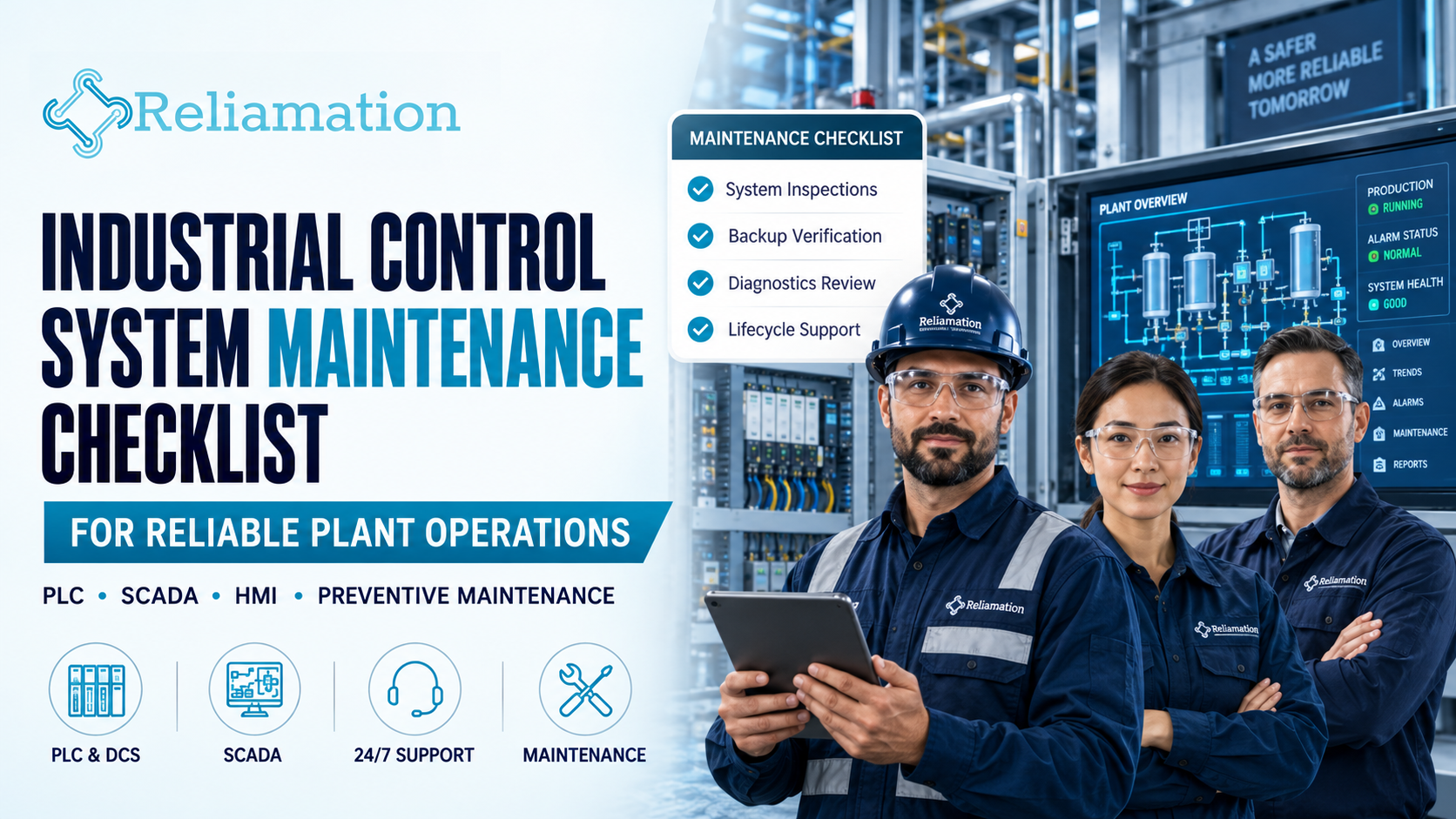
Industrial control systems are expected to operate reliably for years. However, PLCs, SCADA systems, HMIs, industrial networks, power supplies and field devices all require ongoing attention.
Without a structured industrial control system maintenance plan, small problems can develop into production interruptions, difficult troubleshooting and expensive emergency repairs.
For this reason, preventive maintenance should not begin only after a failure occurs. Instead, manufacturers should regularly review control-system hardware, software, communications, backups and diagnostic information.
Reliamation provides annual maintenance services designed to improve control-system reliability, identify potential issues early and support the long-term performance of industrial automation systems.
What Is Industrial Control System Maintenance?
Industrial control system maintenance is the planned inspection, testing, monitoring and servicing of automation equipment used to control industrial processes.
Depending on the facility, this can include:
- PLCs
- DCS controllers
- SCADA servers
- HMIs
- Industrial computers
- I/O modules
- Network switches
- Power supplies
- VFDs
- Remote I/O
- Instrumentation
- Communication networks
In addition, maintenance should include software, backups, documentation and system configuration—not only physical equipment.
A strong maintenance program helps plant teams identify deteriorating equipment before it becomes a production problem.
1. Inspect PLC and Control Panel Hardware
The control panel is a good place to begin a preventive maintenance inspection.
Engineers or qualified maintenance personnel should inspect:
- PLC processors
- I/O modules
- Power supplies
- Terminal blocks
- Ethernet switches
- Communication modules
- Cooling fans
- Panel filters
- Wiring connections
- Indicators and diagnostic LEDs
In addition, panels should be checked for excessive heat, dust, moisture or vibration.
Loose wiring, blocked ventilation or failing power supplies can create intermittent faults that are difficult to diagnose during production.
2. Review PLC Diagnostic Information
Modern PLC platforms provide diagnostic information that can reveal developing problems.
For example, maintenance personnel may review:
- Controller faults
- I/O errors
- Communication faults
- Module status
- Battery conditions where applicable
- Network connection status
- Major and minor controller faults
Therefore, PLC diagnostics should be reviewed during planned maintenance rather than only after a machine stops.
Recurring warnings may provide useful information before a complete failure occurs.
3. Verify PLC Program Backups
A current PLC backup is one of the most important assets during an automation failure.
However, many plants discover during an emergency that their stored program is outdated.
As part of control-system maintenance, verify that:
- Current PLC programs are archived
- File names and revision dates are clear
- Backup locations are documented
- Passwords and access information are controlled
- Latest approved changes are included
In addition, backups should be created after major programming changes.
A backup is most valuable when the maintenance team knows exactly which file represents the current operating system.
4. Check HMI and SCADA System Health
HMI and SCADA systems should also be included in the maintenance schedule.
Typical checks may include:
- Server status
- HMI communication
- Alarm functionality
- Historical data collection
- Trend displays
- Disk space
- Application errors
- User accounts
- System time synchronization
- Backup status
For example, a SCADA application may appear operational while historian storage is nearly full or a secondary communication path has failed.
Therefore, system health should be reviewed beyond the operator screen alone.
5. Inspect Industrial Network Performance
Modern control systems depend heavily on industrial Ethernet and communication networks.
A network problem can affect multiple machines or process areas at the same time.
During maintenance, engineers may verify:
- Switch status
- Port errors
- Device connectivity
- Communication fault history
- Network utilization
- Cable condition
- Fiber connections
- Redundant network paths
- IP address documentation
In addition, unexpected network changes should be investigated.
A well-maintained control network makes troubleshooting easier when production issues occur.
6. Review Alarms and Recurring Faults
Alarm history can provide valuable maintenance information.
Instead of only acknowledging alarms, maintenance teams should look for patterns.
For instance:
- Does the same motor fault repeatedly?
- Does one communication device disconnect frequently?
- Does a temperature alarm occur during the same production condition?
- Is one sensor generating repeated bad-value alarms?
As a result, alarm history can help maintenance teams identify recurring problems before they become larger failures.
7. Verify Industrial Power Supplies
Control-system power supplies are often overlooked until they fail.
However, unstable power can create PLC resets, communication faults and unexpected equipment behavior.
Maintenance checks may include:
- Power-supply status
- Output voltage
- Redundant power-supply health
- UPS condition
- Battery condition
- Grounding
- Surge protection
In addition, facilities should investigate repeated power-related alarms instead of treating them as isolated incidents.
8. Clean and Inspect Control Cabinets
Dust and heat can reduce the reliability of industrial electronics.
Therefore, cabinets should be inspected for:
- Dust buildup
- Blocked air filters
- Failed cooling fans
- Excessive temperature
- Moisture
- Corrosion
- Loose components
However, cleaning should be performed using appropriate methods for energized or sensitive electrical equipment.
The goal is to maintain suitable environmental conditions without introducing additional risk.
9. Review VFD and Motor Control Diagnostics
Variable Frequency Drives often provide detailed operating and fault information.
Maintenance teams may review:
- Fault history
- Overcurrent events
- Overtemperature events
- DC bus conditions
- Communication errors
- Run hours
- Cooling fan condition
For example, repeated overtemperature alarms may indicate an airflow problem before the drive experiences a complete failure.
Therefore, drive diagnostics can support more proactive maintenance.
10. Check Instrumentation and Field Signals
Reliable control depends on reliable field data.
Sensors and transmitters should be reviewed for:
- Calibration status
- Signal stability
- Scaling
- Wiring condition
- Communication status
- Drift
- Physical damage
In addition, analog values should be compared with expected process conditions.
A PLC can only make correct control decisions when the field signal is accurate.
11. Review System Documentation
Accurate documentation significantly reduces troubleshooting time.
During maintenance, confirm that the following documents match the installed system:
- Electrical drawings
- Network diagrams
- I/O lists
- PLC hardware configuration
- Device addresses
- Control narratives
- HMI documentation
- Backup records
If changes have been made in the field, the documentation should be updated accordingly.
Otherwise, future maintenance work may be based on outdated information.
12. Check Spare Parts Availability
Legacy or critical automation components should have a clear spare-parts strategy.
Important spare items may include:
- PLC processors
- I/O modules
- Communication cards
- Power supplies
- HMI hardware
- Industrial switches
- Critical VFD components
In addition, maintenance teams should review whether older hardware is still commercially supported.
If spare parts are difficult to obtain, the facility may need a modernization or migration plan rather than depending on emergency purchases.
13. Perform Predictive Maintenance Where Practical
Preventive maintenance is schedule-based. Predictive maintenance, by contrast, uses actual equipment condition to help determine when maintenance is required.
Condition-monitoring data may include:
- Temperature
- Vibration
- Electrical measurements
- Diagnostic alarms
- Equipment runtime
- Process performance
Reliamation’s Annual Maintenance Services page specifically includes predictive maintenance and condition monitoring as part of its proactive maintenance approach.
In modern control environments, diagnostic data can help maintenance teams focus attention on assets showing early signs of deterioration.
Siemens, for example, describes plant asset management systems that monitor automation hardware, network components and field devices to identify maintenance requirements and support targeted intervention.
14. Plan Software and Hardware Upgrades
Maintenance should also include lifecycle planning.
Control systems can remain operational for many years. However, hardware and software eventually become obsolete.
During periodic reviews, consider:
- Vendor support status
- Operating-system support
- Software compatibility
- Spare-parts availability
- Cybersecurity limitations
- Engineering software availability
- Migration options
As a result, facilities can plan upgrades before obsolete equipment creates an emergency.
Reliamation’s maintenance service also includes system upgrades, enhancements and long-term lifecycle planning.
15. Document Every Maintenance Activity
Finally, maintenance work should be documented.
A maintenance report may include:
- Date of inspection
- Equipment reviewed
- Faults identified
- Repairs completed
- Programs backed up
- Parts replaced
- Outstanding recommendations
- Future actions
This history becomes valuable when troubleshooting recurring problems.
In addition, maintenance records help engineering teams understand how the system has changed over time.
Industrial Control System Maintenance Checklist
Use this industrial control system maintenance checklist during scheduled maintenance to review PLC, SCADA, network, electrical, and field-device reliability.
PLC System
- Controller status checked
- PLC faults reviewed
- I/O module status verified
- Program backup confirmed
- Communication modules checked
HMI and SCADA
- Communication verified
- Alarm system tested
- Historian status checked
- Disk capacity reviewed
- Application backups verified
Industrial Network
- Switch diagnostics reviewed
- Network errors checked
- Device connectivity confirmed
- Cables and fiber inspected
Electrical and Panel
- Power supplies checked
- UPS inspected
- Panel temperature reviewed
- Filters and fans inspected
- Wiring condition checked
Field Equipment
- Sensor signals reviewed
- Instrument calibration verified
- VFD diagnostics checked
- Critical fault history reviewed
Documentation
- Electrical drawings updated
- Network diagram current
- Backup records updated
- Spare-parts list reviewed
- Maintenance report completed
Preventive vs Predictive Maintenance
Both approaches can support reliable plant operation.
Preventive maintenance is performed according to a planned schedule.
For example, a facility may inspect control panels every quarter and review backups every month.
Predictive maintenance, on the other hand, uses equipment condition and diagnostic data to determine when maintenance should occur.
For example, increasing temperature, vibration or electrical abnormalities may indicate that equipment requires attention.
In practice, many industrial facilities benefit from using both methods together.
Why Regular Control System Maintenance Matters
A structured maintenance program can help:
- Reduce unexpected downtime
- Detect developing faults
- Improve troubleshooting
- Protect PLC and SCADA backups
- Improve system reliability
- Support lifecycle planning
- Reduce emergency repairs
- Improve documentation quality
More importantly, maintenance helps facilities move from reactive troubleshooting toward planned control-system management.
Reliamation Annual Maintenance Services
Reliamation provides Annual Maintenance Services for industrial control and automation systems.
The company’s maintenance offering includes scheduled preventive maintenance, predictive maintenance and condition monitoring, emergency support, system upgrades, documentation and lifecycle planning.
For plants that depend on PLC, SCADA, HMI and industrial network infrastructure, a structured maintenance program can help protect system reliability while supporting long-term modernization planning.
Need Support Maintaining Your Industrial Control System?
Contact Reliamation to discuss preventive maintenance, troubleshooting, automation upgrades and long-term control-system support.
Frequently Asked Questions
What is industrial control system maintenance?
Industrial control system maintenance is the planned inspection, testing and servicing of PLCs, SCADA systems, HMIs, industrial networks and related automation equipment.
How often should PLC systems be maintained?
The maintenance schedule depends on equipment type, environmental conditions, process criticality and manufacturer recommendations. Critical systems may require more frequent inspection and diagnostic review than non-critical equipment.
What should be included in a PLC maintenance checklist?
Typical items include PLC diagnostic checks, I/O status, power-supply condition, communication health, program backups, panel condition and documentation review.
Why are PLC backups important?
A current backup can help restore a control system after hardware replacement, program corruption or an unexpected configuration problem.
What is the difference between preventive and predictive maintenance?
Preventive maintenance is performed on a planned schedule. Predictive maintenance uses equipment condition and diagnostic data to help determine when maintenance is needed.
Can preventive maintenance reduce plant downtime?
A structured maintenance program can identify developing issues before they result in equipment failure. Therefore, it can reduce avoidable downtime and improve troubleshooting readiness.
When should an old control system be upgraded instead of maintained?
Facilities should consider modernization when hardware is obsolete, vendor support has ended, spare parts are difficult to obtain, or the system no longer meets operational requirements.
Frequently Asked Questions
Get answers to common questions about industrial automation, PLC migration, HMI, SCADA, and control-system integration.
Reliamation provides industrial automation services including PLC programming, HMI and SCADA development, control system integration, legacy control-system migration, industrial networking, data reporting, system troubleshooting, and automation modernization.
Yes. Reliamation helps manufacturers migrate legacy platforms such as PLC-5 and SLC 500 to modern ControlLogix and CompactLogix systems while minimizing production disruption and preserving essential control functionality.
A PLC controls machines and industrial processes, an HMI allows operators to interact with equipment, and a SCADA system provides plant-wide monitoring, control, alarms, historical data, and reporting.
Yes. Reliamation develops custom HMI and SCADA solutions designed around each facility’s equipment, operating requirements, alarm strategy, security standards, and reporting needs.
In many cases, yes. A phased modernization approach can retain compatible equipment while replacing obsolete controllers, communication networks, operator interfaces, and other high-risk components.
Reliamation’s automation and control-system solutions can support manufacturing, food and beverage, plastics, packaging, material handling, water treatment, energy, and other process-driven industries.
Industrial automation can reduce downtime through reliable controls, real-time alarms, equipment diagnostics, historical data, preventive-maintenance insights, and faster troubleshooting.
You can contact Reliamation through the website to discuss your existing control system, operational challenges, modernization requirements, and project goals with an industrial automation specialist.